
Your team has the talent.
So why is performance
still constrained?
Decisions slow. Execution fragments. Important issues stay unspoken. Investing in individuals won’t fix this. Most teams don’t have a talent problem. They have a performance constraint problem.
150,000+ profiler responses · 300+ organisations · trusted by teams at Zurich, SSE and Nasdaq
Dominant Constraint
Low Candour
Relevant Benchmark 6.4
Remove what puts
team performance at risk.
Meta Team identifies and removes the team constraints putting strategy, transformation and delivery at risk. Without that diagnosis, organisations often respond to the symptoms: more meetings, another restructure, a broad development programme or a better offsite. Activity increases. The constraint remains.
Decisions Slow
Important calls travel upwards or circle without resolution.
Priorities Multiply
Everything matters, so attention and ownership fragment.
Dependencies Break
Teams optimise their part while shared outcomes suffer.
Delivery Becomes Less Reliable
Strategy depends on performance the team cannot yet repeat.
Know when it’s time to bring in Meta Team.
We’re brought in to work with teams that are in distress, in disruption, under delivery pressure, or delivering in the aftermath of a deal.
Distress
Poor performance, in turnaround.
Disruption
Organisational change, market change, or consolidation in the sector.
Delivery Pressures
Delivery assurance is needed, the team is capable and equipped to deliver on the strategy.
Deal
Post M&A or investment, the deal is done, and the team now has to deliver.
The business impact depends on where you sit.
The language changes by buyer. The underlying team performance problem does not.
CEO
Strategy fails to become coordinated action.
COO
Decisions slow and delivery becomes unreliable.
CFO
Priorities blur, effort duplicates and value leaks.
CHRO / CPO
Talent investment fails to change collective performance.
Transformation Leader
Dependencies and stakeholder friction block delivery.
Team type provides the context.
The diagnostic identifies the constraint.
The constraint determines the workout sequence, not a pre-set programme.
Leadership Teams
Turn strategic choices into aligned organisational action.
- Low Candour
- Signal Distortion
- Decision Drift
- Execution Fragmentation
Enabling Teams
Help the organisation perform through expertise, influence and service.
- Demand Ambiguity
- Stakeholder Misalignment
- Blocked Insight Flow
- Operational Friction
Delivery Teams
Coordinate dependencies and execute reliably against outcomes.
- Execution Ambiguity
- Slow to Adjust
- Execution Drift
- Unstable Delivery
Most diagnostics describe the team.
Meta Team sequences the work.
We reveal the performance constraint, turn it into focused practice on real work, and remeasure what changed, through a disciplined sequence, not a generic programme.
Diagnose
Multi-rater evidence benchmarks the team to reveal its dominant constraint, not another average score.
Sequence
The system selects and orders the workouts most likely to remove this team’s constraint.
Embed
The team applies new habits to consequential, real work.
Remeasure
A reprofile shows what shifted, what held, and where the next constraint sits.
See the constraint in context.
Not as another average score.
Compare the team with relevant benchmark groups. Expose where the leader, team, line manager and stakeholders experience the team differently. Then identify the behaviour most likely to cap performance.
Explore the diagnostic →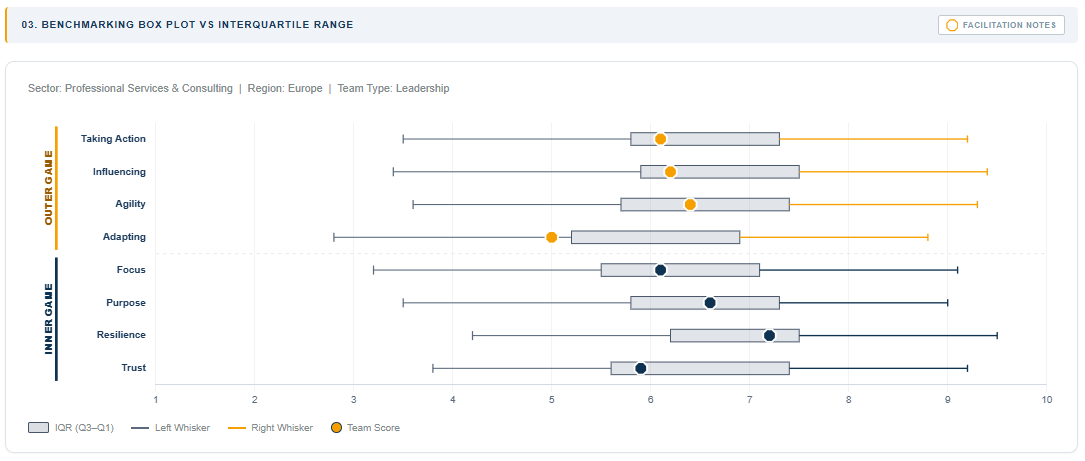
Relevant benchmarks. Range, cohort and difference are visible, not hidden behind a generic norm.
A workout journey built around
this team’s constraint.
Short, applied sessions change how the team handles the work that matters: priorities, decisions, stakeholders, dependencies, pace and challenge. The sequence changes as the evidence changes.
See how the workouts work →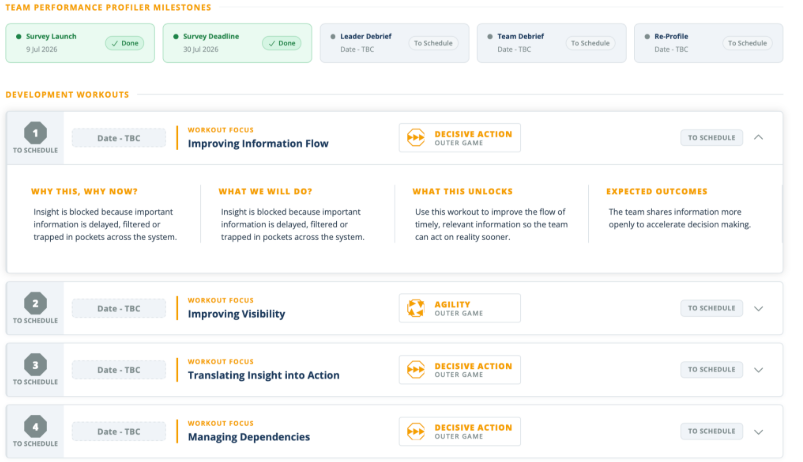
From diagnosis to practice. A specific sequence, followed by remeasurement, not a catalogue of workshops.
Profile-score gains recorded by teams remeasured after 6–12 months.
From decision by committee to stronger collective ownership.
Across a ten-month leadership-team journey, reprofiling recorded a 17.2% overall profile-score improvement and a 28% increase in Trust. The client reported greater pace in decisions and execution.
Read the case evidence →Selected Clients and Strategic Relationships
Strategic Partners




Recent Clients